info@spcprecision.com
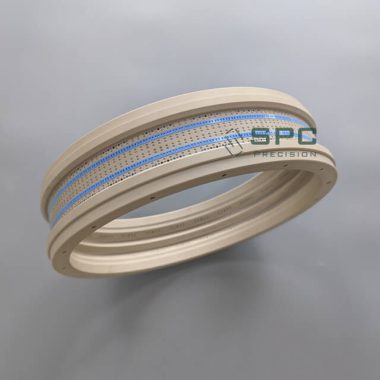
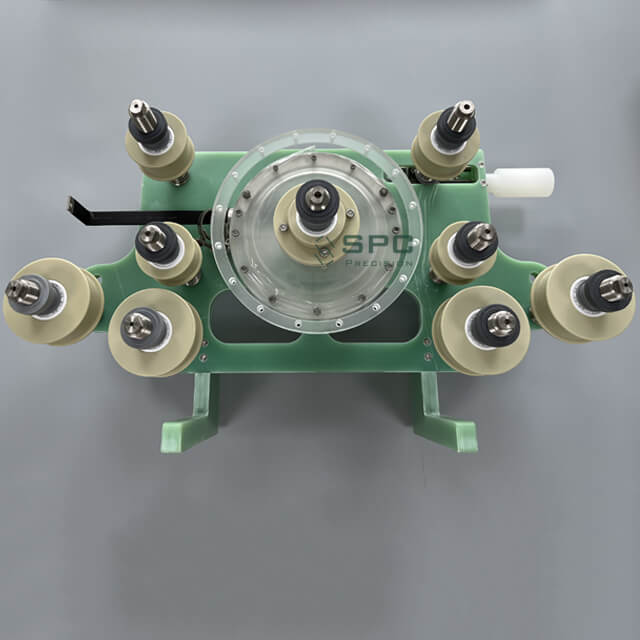
 Spot Plating Drum used in REEL to REEL Selective Plating/Hoop Plating
Reel to reel selective plating is an efficient and economical way of plating. It is a unique process that allows for precise deposit of metal on stamped product. It provides several valuable benefits that other plating methods do not.
Constantly escalating prices of gold, palladium, silver, and other metals have made precious metal conservation essential.
Manufacturers of connectors, capacitors, and other electrical components continuously search for innovative ways to reduce costs.
The parts will be masked in all locations except the areas that require selective plating. Limiting precious metals, such as gold and palladium, to critical locations greatly reduces the amounts used during the electroplating process, thereby reduces costs.
Why Use Selective Plating Tools / Spot Plating Drums?
Selective plating technology offers several important advantages for manufacturers using precious metals in electroplating
Reduce Precious Metal Consumption
Selective plating allows precious metals such as gold or palladium to be applied only to functional areas. This can reduce metal consumption by 30% to 80%, depending on the product design.
Lower Production Cost
Since precious metals represent a significant portion of plating cost, reducing the plated area can dramatically lower overall manufacturing expenses.
High Plating Precision
Selective plating tools are designed to control the contact area between the wheel and the component, ensuring accurate deposition on the required plating zones.
Customized Tooling Design
Each plating tool can be customized according to the geometry of the component, the plating area, and the plating line configuration.
How Selective Plating Tools / Spot Plating Drums Work
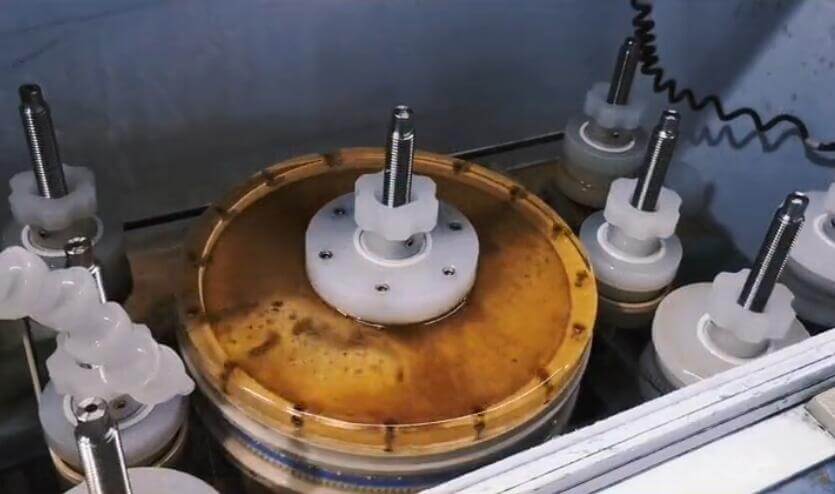
During the electroplating process, the plating tool rotates and comes into controlled contact with the component surface.
The plating solution is transferred through the plating tool to the target plating area while maintaining stable contact pressure. This allows the plating current and electrolyte to reach only the desired surface region.
Because the plating tool only contacts specific areas, precious metal deposition occurs only where it is needed.
This process enables manufacturers to maintain excellent plating quality while significantly reducing material consumption.
Custom Selective Plating Tool / Spot Plating Drum Design
Every plating application is different. The shape of the component, plating area, and plating equipment configuration all influence the design of the plating tool.
Our engineering team designs custom selective plating wheels based on the following factors:
- Component geometry
• Target plating area
• Plating thickness requirements
• Electroplating equipment type
• Production speed and pressure control
Customers can provide drawings or sample parts, and our engineers will analyze the plating requirements to design an optimized plating tool structure.
This customized design ensures stable plating performance and maximum precious metal savings.
Applications of Selective Plating Tools / Spot Plating Drums
Selective plating Tools are widely used in industries where precious metal plating is required on specific functional areas.
Typical applications include:
Connector manufacturing
Electronic components
Semiconductor parts
Automotive electrical connectors
PCB contact componentsPCB
High-reliability electrical contacts
In these industries, gold plating is often required only on contact surfaces, making selective plating an ideal solution for cost reduction.
Selective Spot plating


Selective Stripe plating

Metals used with selective plating
Gold-plated products are generally: DDR, BTB, FPC, BATTERY, MNI-CARD, USB, PCI, JACK and other sheet continuous selective plating;
Silver-plated products are generally: LED, SOT, lead frame and other continuous selective electroplating.
Why Choose Our Selective Plating Tools / Spot Plating Drums?
We specialize in designing and manufacturing precision electroplating tools for selective plating applications.
Our advantages include:
Custom plating wheel design based on customer components
Extensive experience in electroplating tooling
Precision manufacturing for stable plating performance
Support for various precious metal plating processes
Fast design and production response
Our goal is to help customers improve plating efficiency while minimizing precious metal consumption.
SPC Precision can supply unique selective plating tools solutions to your specific plating needs.
The advantages of SPC PEEK selective plating Tools
1. High temperature resistance. The continuous use temperature of PEEK is 260 degrees Celsius.
2. Excellent anti-friction and wear resistance. The PEEK plating wheel is highly electroplated with the guide roller and tension control belt. At this speed and pressure, the PEEK plating wheel can guarantee a minimum life of two years.
3. Chemical resistance. The chemical components in the electroplating environment are generally gold, silver, potassium cyanide, citric acid, conductive salts, balanced salts, etc. PEEK plating fixture will not corrode at all under these chemicals.
4. Hydrolysis resistance. PEEK plating tools can resist damage caused by water or high pressure steam, PEEK plating tools can be used continuously in high temperature and high pressure water and maintain good mechanical properties.

PEEK material properties
| Variation of thermal expansion coefficient at different temperatures | |||||
| 20℃ | 50℃ | 100℃ | 150℃ | 200℃ | |
| PEEK-N | — | 4.62*10-5℃ | 4.66*10-5℃ | 4.8*10-5℃ | 6.33*10-5℃ |
| Effect of different acidic solutions on material size | |||||
| Solvents | PEEK-N | ||||
| 15%HCI | -0.01mm | ||||
| 15%H2SO4 | -0.001mm | ||||
| 20%H2SO4 | -0.02mm | ||||
| 20%HNO3 | -0.01mm | ||||
| Material properties | |||||
| Item | Test Standard | PEEK-N | |||
| Mechanical properties | |||||
| Tensile strength (Mpa) | ISO 527-2 | 102 | |||
| Elongation at break | ISO 527-2 | 14.5% | |||
| Bending strength (Mpa) | ISO 178 | 173 | |||
| Impact strength( KJ/M2) | ISO 179-2 | No Break | |||
| Thermal properties | |||||
| Melting point | ISO 11357 | 334℃ | |||
| Glass transition temperature | ISO 11357 | 143℃ | |||
| Long time using temperaature | UL 74685 | 260℃ | |||
| Electrical properties | |||||
| Dielectric strength | IEC 602431(2mm) | 19 | |||
| Dielectric constant | IEC 60250(1KHz) | 3.2% | |||